Emergency Tax Code:
What It Means
Last reviewed: April 2026
An emergency tax code causes most people to overpay tax. Learn what your code means, why it was applied, and the exact steps to get your money back quickly.
At a glance
- ✓Emergency codes (BR, 1257L W1/M1) are applied when HMRC lacks your employment information
- ✓They ignore year-to-date figures and almost always cause overpayment
- ✓Fix: give your employer your P45 or complete a Starter Checklist
- ✓Overpaid tax is refunded automatically once the correct code is issued
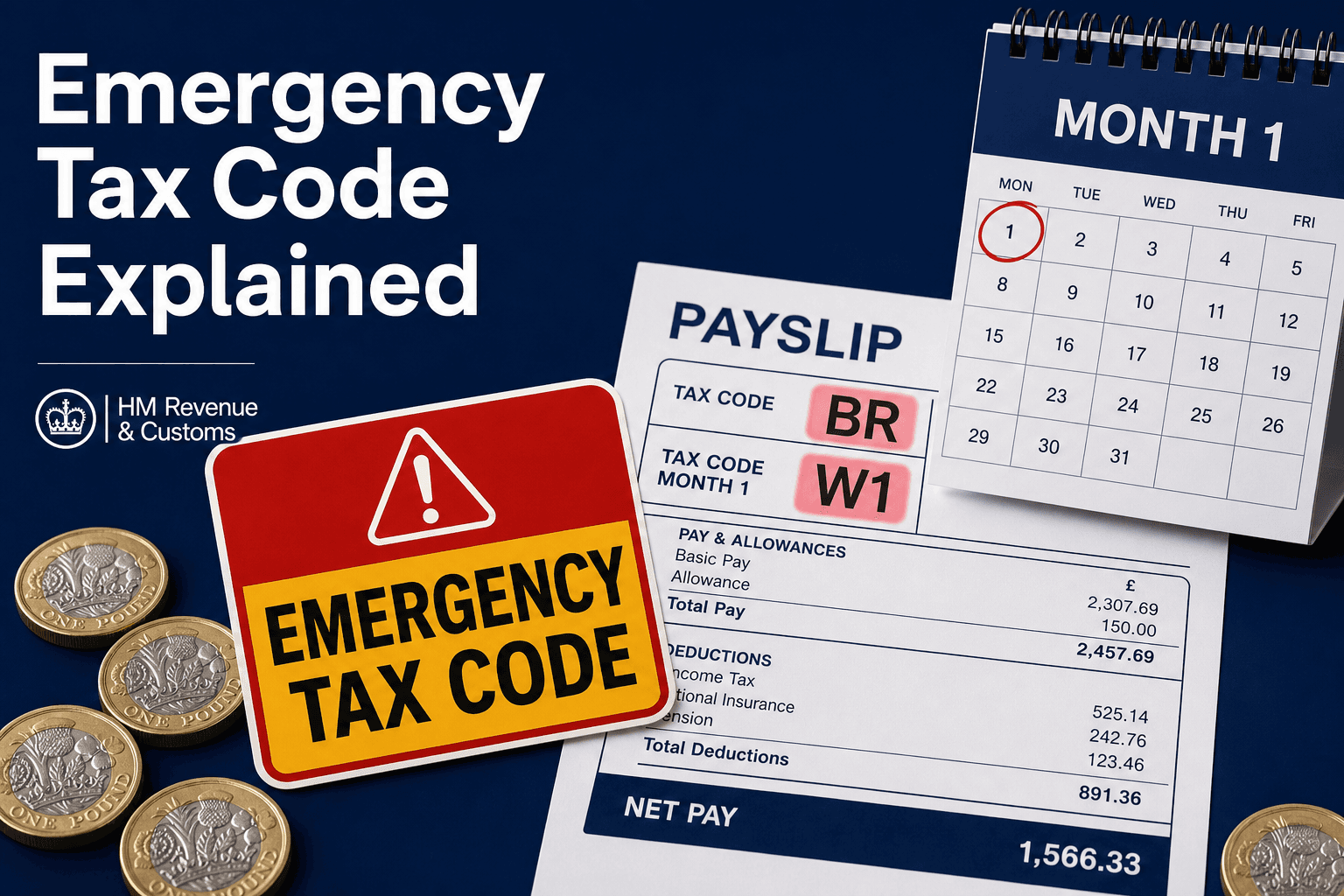
What is an emergency tax code?
An emergency tax code is a temporary code your employer uses when HMRC cannot provide your correct tax information in time. It is designed to prevent you from underpaying tax — but in most cases it results in overpayment.
The most important characteristic of emergency codes is that they are non-cumulative. A normal tax code (like 1257L) looks at your total pay and tax for the year so far, and adjusts each payslip accordingly. An emergency code treats each pay period in isolation — it does not consider what you earned or paid before. This causes overpayment when your earnings earlier in the year were lower, or when you had unused personal allowance from a previous employer.
Common emergency tax codes
Month 1 / Week 1 basis on standard allowance — most common. Calculated per period with no running total.
Overpayment risk: Likely if earnings vary or if previous employer paid you well this year.
Same as W1 but for monthly-paid employees. Non-cumulative personal allowance applied each month.
Overpayment risk: Likely — your year-to-date earnings from previous employment are ignored.
Basic rate — 20% on all earnings, no personal allowance applied.
Overpayment risk: Almost certain if this is your only job or first job of the year.
No personal allowance at all — taxed at 20%, 40% or 45% depending on income band.
Overpayment risk: High — often the most punishing emergency code.
How to fix an emergency tax code
Give your employer a P45
If you have a P45 from your previous employer, hand it to your new employer's payroll department immediately. They can update your code and HMRC will issue the correct one automatically.
Complete a Starter Checklist
If you have no P45 (first job, returning from self-employment, coming from abroad), complete a Starter Checklist accurately. Choosing statement A gives you the best code for most people starting their first job of the tax year.
Log in to your Personal Tax Account
At gov.uk/personal-tax-account you can see your current tax code and update your employment information directly. This often triggers HMRC to send a new code to your employer within days.
Call HMRC directly
HMRC's income tax helpline is 0300 200 3300 (Mon–Fri 8am–6pm). Have your National Insurance number ready. They can update your code and you should see the change on your next payslip.
Your employer refunds the overpayment
Once your employer receives the correct code from HMRC, they will calculate the overpayment and add it to your next pay packet automatically. If the tax year ends before this is resolved, HMRC issues a P800 and refund.
How much are you likely overpaying?
If you are on code BR and earning £2,000 per month, you are paying £400 per month in tax instead of the £144 you would owe on a cumulative 1257L code — an overpayment of approximately £256 each month. Over six months that adds up to over £1,500.
Quick estimate: monthly salary of £2,000
On BR (emergency)
£400
20% on all earnings
On 1257L (correct)
~£144
20% on income above allowance
Difference: £256/month. Use the calculator below for your exact figures.
Frequently asked questions
What is an emergency tax code?
An emergency tax code is a temporary tax code your employer uses when HMRC has not yet provided your full tax information. Common emergency codes are 1257L W1 (week 1 basis), 1257L M1 (month 1 basis) or BR (basic rate on all earnings). They often cause overpayment because they ignore your year-to-date earnings.
Why have I been put on an emergency tax code?
Emergency codes are used when you start a new job without a P45, return to work after a break, start your first ever job, or take on a second employment. Your employer must deduct tax using a temporary code until HMRC sends the correct one.
How do I get a refund of emergency tax?
Once HMRC updates your tax code to the correct one, your employer will automatically refund any overpaid tax through your payslip (usually within one or two pay periods). You can speed this up by calling HMRC on 0300 200 3300 or using your Personal Tax Account online to update your employment details.
What is the difference between W1 and M1 emergency tax codes?
Both W1 (week 1) and M1 (month 1) are non-cumulative emergency codes — your employer calculates your tax as if each pay period is independent, not cumulative. W1 is used for weekly-paid employees and M1 for monthly-paid employees. Neither looks at your total pay or tax for the year so far, which often causes overpayment.
Sources
Check if your tax code is correct
Enter your tax code from your payslip to instantly see what it means and whether you might be overpaying.