National Insurance
Explained
Last reviewed: April 2026
National Insurance is a tax on earnings that funds the State Pension and certain benefits. It is often misunderstood — here is a plain-English guide to what you pay, why, and when it stops.
At a glance
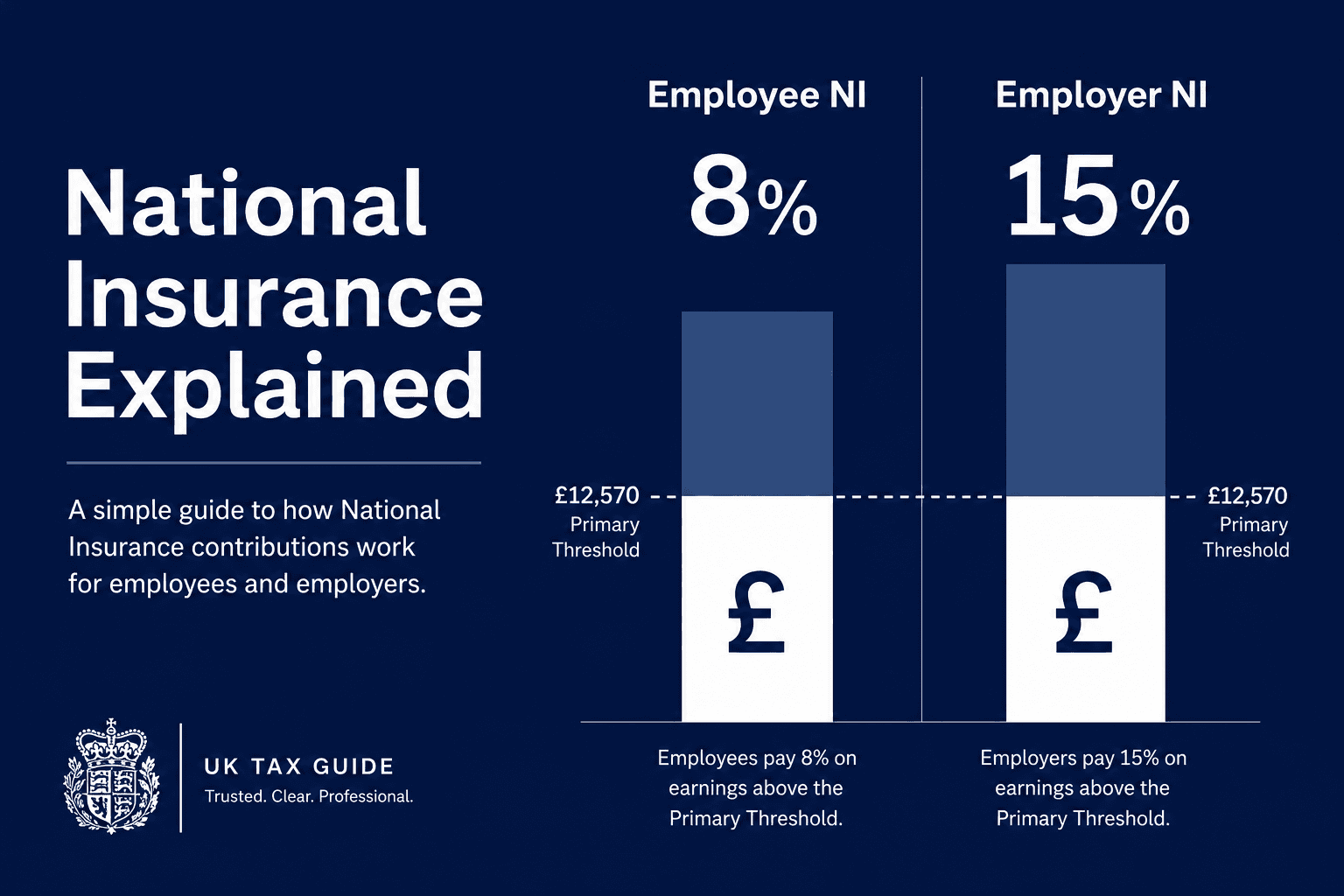
- ✓Employees pay 8% on earnings between £12,570 and £50,270, and 2% above
- ✓Employers pay 15% on earnings above £5,000 (secondary threshold 2026/27)
- ✓NI contributions count towards your State Pension entitlement
- ✓Self-employed pay Class 4 via Self Assessment; Class 2 was abolished April 2024
8%
Employee main rate
£12,570
Primary threshold
£50,270
Upper earnings limit
What is National Insurance?
National Insurance (NI) is a compulsory contribution made by employees, employers and the self-employed. Despite sharing some similarities with income tax — both are deducted from your pay and collected by HMRC — they are separate charges with different rules and purposes.
Your National Insurance record determines your entitlement to the State Pension and certain contributory benefits. Each year in which you earn above the lower earnings limit (£6,396 in 2026/27) and make NI contributions counts as a qualifying year. You generally need 35 qualifying years for the full new State Pension of around £11,500 per year.
You can check your NI record and State Pension forecast through the government's online Personal Tax Account. If you have gaps in your record — perhaps from time spent abroad, caring responsibilities or low income periods — you may be able to make voluntary Class 3 contributions to fill them.
Employee NI rates 2026/27 (Class 1)
These rates apply to employed earners. Your employer deducts NI from your gross pay each pay period before you receive it.
| Annual earnings | NI rate | Note |
|---|---|---|
| Below £12,570/yr | 0% | Primary threshold |
| £12,570 – £50,270/yr | 8% | Main rate |
| Above £50,270/yr | 2% | Upper earnings limit |
Employer NI (Class 1 secondary)
Your employer also pays National Insurance on your behalf — this does not come from your pay but is an additional cost of employing you. For 2026/27 employers pay 15% on earnings above £5,000 per year (the secondary threshold, reduced from £9,100 in the 2024 Autumn Budget). The Employment Allowance offsets up to £10,500 of employer NI for eligible businesses.
Self-employed NI rates 2026/27
Self-employed people pay two types of National Insurance on their business profits.
Class 2 NI
£3.45/week
Paid if profits exceed the small profits threshold (£6,725). Paid via Self Assessment. Counts toward State Pension.
Class 4 NI
6% / 2%
6% on profits £12,570–£50,270. 2% above £50,270. Paid via Self Assessment. Does not count toward State Pension entitlement directly.
Use our self-employed tax calculator to estimate your total NI and income tax bill.
When do you stop paying National Insurance?
Reaching State Pension age
Employee NI contributions automatically stop when you reach State Pension age (currently 66). Your employer must stop deducting them. You do not need to apply — your employer should update their payroll when you provide proof of age.
Earnings below the primary threshold
You do not pay employee NI on earnings below £12,570 per year (£1,047.50/month). However, if you earn between £6,396 and £12,570, you are treated as paying NI at a zero rate — meaning the year still counts toward your State Pension record.
Earning below the lower earnings limit
If you earn less than £6,396 per year, the year does not automatically count as a qualifying year for State Pension purposes. You may want to consider making voluntary Class 3 contributions (£17.45/week in 2026/27) to fill the gap.
Frequently asked questions
How much National Insurance do I pay in 2026/27?
Employees pay 8% National Insurance on earnings between £12,570 and £50,270 per year, and 2% on earnings above £50,270. You pay nothing on the first £12,570 (the primary threshold, which matches the personal allowance).
What does National Insurance pay for?
National Insurance contributions build your entitlement to the State Pension, contributory Jobseeker's Allowance, contributory Employment and Support Allowance, Maternity Allowance and bereavement benefits. You generally need 35 qualifying years to receive the full new State Pension.
Do I still pay National Insurance after State Pension age?
No. Once you reach State Pension age you stop paying employee National Insurance contributions, even if you continue to work. Your employer still pays their contributions on your wages.
What is the difference between Class 1, Class 2 and Class 4 NI?
Class 1 NI is paid by employees and employers on employment income. Class 2 NI (£3.45/week in 2025/26) is paid by self-employed people with profits above the small profits threshold. Class 4 NI (6% on profits £12,570-£50,270, 2% above) is also paid by the self-employed and is profit-based.
Sources
See your exact NI deductions
Enter your salary in our calculator to see a full breakdown of income tax and National Insurance for 2026/27.