Scottish Income Tax Rates 2026/27
Last reviewed: April 2026
Scotland operates a six-band income tax system that diverges from England and Wales above £26,561. Scottish taxpayers on higher incomes can pay significantly more.
At a glance
- ✓Scotland has 6 income tax bands vs 4 in England — including a 42% higher rate from £43,663
- ✓Scottish rates only apply to employment, self-employment, pension and rental income — not savings or dividends
- ✓Your tax code will have an 'S' prefix if HMRC has you as a Scottish taxpayer
- ✓A Scottish taxpayer earning £60,000 pays roughly £2,731 more in income tax than an equivalent English taxpayer
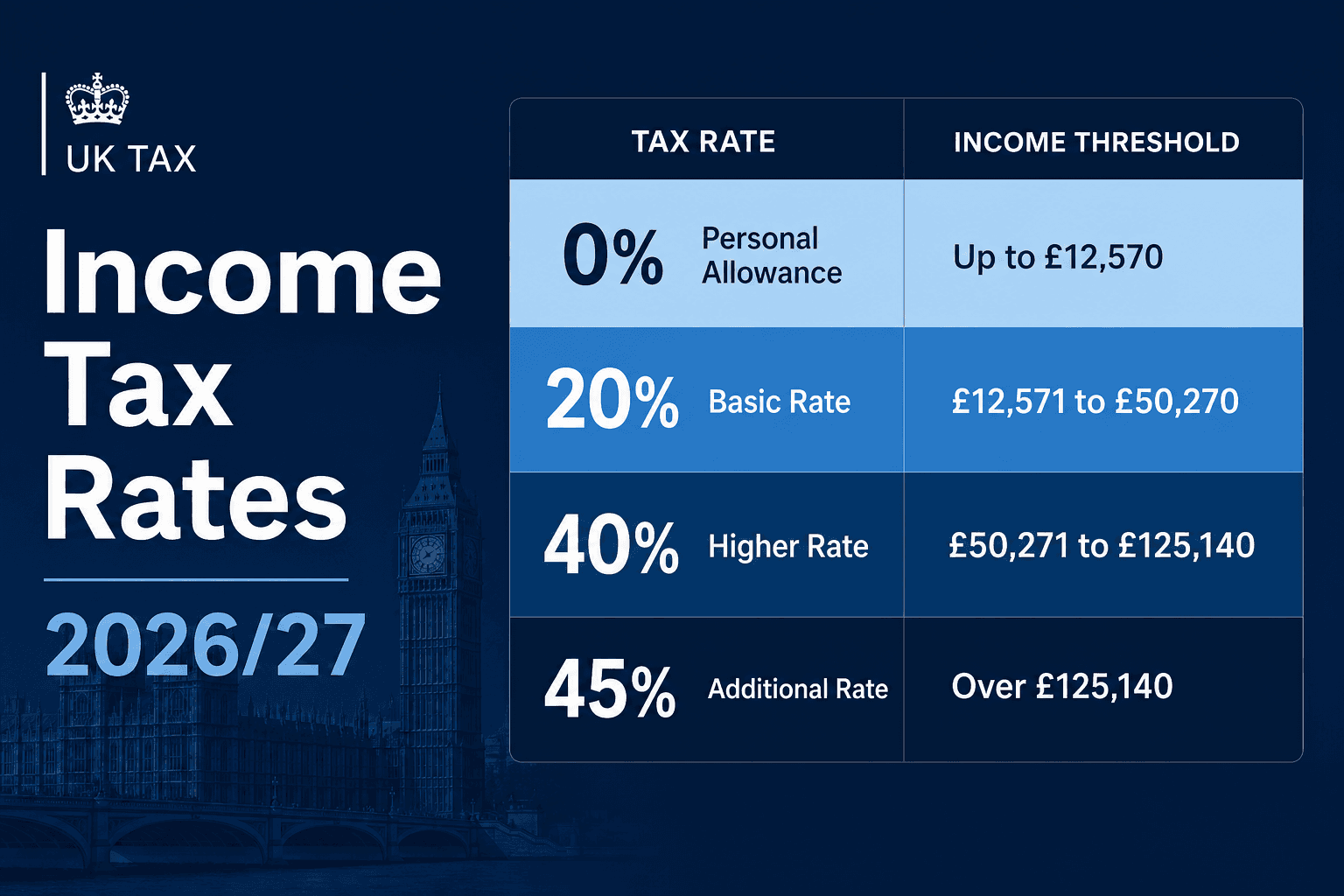
Scottish income tax bands 2026/27
| Band | Income range | Rate |
|---|---|---|
| Personal Allowance | Up to £12,570 | 0% |
| Starter rate | £12,571 – £14,876 | 19% |
| Basic rate | £14,877 – £26,561 | 20% |
| Intermediate rate | £26,562 – £43,662 | 21% |
| Higher rate | £43,663 – £75,000 | 42% |
| Advanced rate | £75,001 – £125,140 | 45% |
| Top rate | £125,141 – No limit | 48% |
Personal Allowance is reduced by £1 for every £2 of income above £100,000, fully withdrawn at £125,140.
Scotland vs England: income tax comparison 2026/27
Scottish and English income tax is identical up to £26,561. Above that, Scottish taxpayers pay more — particularly between £43,663 and £125,140 where Scottish rates are 2–5 percentage points higher.
| Gross salary | Scotland (income tax) | England (income tax) | Difference |
|---|---|---|---|
| £30,000 | £3,633 | £3,486 | +£147 |
| £40,000 | £5,753 | £5,486 | +£267 |
| £50,000 | £8,263 | £7,486 | +£777 |
| £60,000 | £14,163 | £11,432 | +£2,731 |
| £80,000 | £24,163 | £19,432 | +£4,731 |
Figures are approximate income tax only. NI is the same across the UK. Use the salary calculator for a precise breakdown.
How Scottish income tax works
Scottish income tax is collected by HMRC on behalf of the Scottish Government. It does not require you to file a Scottish tax return — your employer deducts the correct amount via PAYE using your Scottish tax code, which has an 'S' prefix (e.g. S1257L).
Only your non-savings, non-dividend income is subject to Scottish rates. This includes wages, self-employment profits, pension income and rental income. Savings interest is taxed at UK-wide rates (0% starter savings rate, then 20%/40%/45%), and dividend income is taxed at UK-wide dividend rates for everyone regardless of where they live.
If you move to or from Scotland during the tax year, HMRC determines your status based on your main residence on 6 April — the start of the tax year. Day counting during the year is not used for income tax purposes (unlike some other tax regimes).
The 21% intermediate rate: Scotland's hidden tax band
Between £26,562 and £43,662, Scottish taxpayers pay 21% income tax versus 20% in England. On its own this is a 1 percentage point difference — worth £171 per year on an income of £43,662. However, this band also interacts with pension contributions and salary sacrifice.
If you earn between £26,562 and £43,662, your pension contributions attract 21% basic-rate relief under net pay arrangements (most workplace schemes), giving you slightly more relief than your English counterpart.
Example: salary sacrifice at the intermediate rate
Scottish worker earning £35,000 sacrifices £3,000/yr into pension. Saving: 21% income tax (£630) + 8% employee NI (£240) = £870 saved. English equivalent saves 20% (£600) + 8% NI (£240) = £840. Scottish worker saves £30 more per year thanks to the higher rate.
Frequently asked questions
Frequently asked questions
How do I know if Scottish income tax applies to me?
Scottish income tax applies to your non-savings, non-dividend income if you are a Scottish taxpayer — meaning your main residence is in Scotland. HMRC determines this each tax year. You will have an 'S' prefix on your tax code (e.g. S1257L).
Do Scottish rates apply to savings and dividend income?
No. Scottish income tax only applies to employment income, pension income, self-employment profits and rental income. Savings interest and dividend income are taxed at UK-wide rates for everyone.
Is Scottish income tax just for Scottish residents?
Yes — it applies to Scottish taxpayers, defined as those whose main UK residence is in Scotland. You do not need to be Scottish by nationality.
Will Scottish rates become even higher in future?
The Scottish Government sets rates each year in its Budget. In recent years it has increased the higher rate to 42% and added the 45% advanced rate. Future changes depend on Holyrood's fiscal decisions.